Hanselminutes on 9 - Spolsky, Atwood, Blyth, Hanselman = Crazy-Delicious || Content-Free?
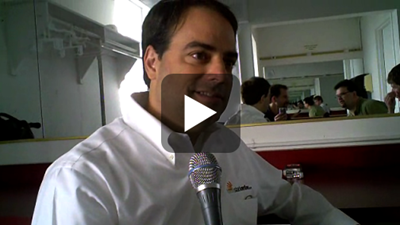 What do you get when you put Spolsky, Atwood, Blyth, and Hanselman in the same room? A crazy Content-Free podcast recorded backstage at the San Francisco DevDays conference.
The video is up at Channel 9, and the audio will be up on Hanselminutes and in the RSS Podcast Feed in the morning. The audio for the actual podcast will include tracks from three locations and will likely be a LOT better, however, be warned, this episode runs a bit longer than usual and the sound quality isn't up to our usual standards.
Warning: extreme ramblosity ahead!
- Joel explains his Duct Tape Programmer post. Apparently DevDays is a duct tape conference, and this section of the recording is a duct tape podcast.
- Some discussion of the ubiquity of mobile code. Also, if you are nostalgic for the era “when development was hard”, the consensus is that you should be doing mobile development today on iPhone, Android, Windows Mobile, or Symbian.
- Rory elaborates on his experience with (and effusive opinions on) iPhone development to date. Is coding in Objective-C best accompanied by a flux capacitor, New Coke, and Max Headroom? Also, his excitement for MonoTouch.
- Joel and Scott put on their amateur language designer hats and have a spirited discussion of type inference and Fog Creek’s in-house DSL, Wasabi.
- Scott covers some of the highlights of new and shiny features coming in the Visual Studio 2010 IDE, the C# 4.0 language, and the ASP.NET MVC 2.0 web framework.
Enjoy! You've been warned.
About Scott
Scott Hanselman is a former professor, former Chief Architect in finance, now speaker, consultant, father, diabetic, and Microsoft employee. He is a failed stand-up comic, a cornrower, and a book author.


About Newsletter

 https://www.google.com/accounts/o8/id?id=AItOawlqWW9QPUUOl1fUhJf-OD7H1k7N-0AdlNg
In any case, this was a great and very entertaining video -- lots of really smart people spewing out a bunch of nonsense ;) -- Please post more!!


sadegh - Really?
MikeC - Thanks!

Is the audio of this conversation also be available as a podcast somewhere? Either on your podcast or the Stack overflow one?
Thanks!
There was good content here - but I didn't like having to wade through all of the blather about trying to make Joel say something bad, where Rory's daughter works, and on and on.
I don't mean to be harsh ... but frankly I don't rely on this podcast for comedy. Some offhand funny comments are fine, but this one (and some other recent ones) feel like the focus on tech is getting lost.
I wish that this podcast had undergone some editing to improve the signal/noise.
That is just my two-cents ... love this podcast and have had many good times ... I just miss the prior focus on very high content-time ratio.
Some people take a lot of effort to give a free podcast. So once a while Scott does a little different podcast than the usual 30 minutes and some people start bitching as if the podcast ruined their day and made them miserable. Some people get so anal about everything, I bet they are never happy. BTW, it's Rory's sister. Not that you care.
Joel REALLY doesn't get it on type inference. And I can't believe he takes Apple to task about their programming experience being behind the times, and he's still all about Wasabi. Little wonder he doesn't know the difference between dynamic typing and type inference.
When I talked to him a couple of years ago, he insisted Wasabi wasn't a DSL, but instead a more general purpose language. Ugh. He's spent too much time talking about programming and definitely not enough time actually doing it.
-D

I really like ur interviews, but cant you do anything to bring down the size of those videos.
by size i mean the file size.
It's great when Rory goes off on a topic, you start throwing jabs at Jeff about his lack of C programming experience, and Joel trying not to piss off the world with every comment he makes. Having you point out the flaws, weaknesses, or maybe experience and trying to put new terms in plain english is awesome! And the fun part is that you all do it out of fun and respect for each other -- it is nice to see non of you take it personally and that is what makes this show entertaining....
I'd love to hear more with Rory and iPhone and MonoTouch. You should really have him on the phone more because he brings any postcast alive with his personal style, opinions, and antecdotes to the show.
Keep up the good work!
I do not hate everything. I am just saying -- look, this episode is the top-of-page link on MSDN right now. I want the content in this episode. I just wanted it in a more concentrated dosage than I received it in. I am not "never happy" as you seem to say.
Peace out.
What I am saying is be happy with what you get. The format of this show is not the trend. It was probably meant for channel 9.. Actually no need to continue. .. you can't please everyone. You don't like it, just delete it.

id x = x
Has type: "a ->a", where "a" is a generic type parameter, which means it takes one 'a' and returns an 'a'. So it's equivalent to the following C# signature:
public T id(T t);
Or consider a function like this:
incr x = x + 1
In that case, a Haskell compiler would use the fact that the "+" operator requires that its operands be part of the typeclass "Num" (don't be confused by the word 'class', typeclasses in Haskell are more like interfaces in C# than classes) to determine the signature of the function. So the compiler can determine that the signature of this function is:
Num a => a -> a(my Haskell syntax is a little shaky so that may not be 100% correct) which means that given a type "a" which is part of the Num typeclass (i.e. implements the Num interface in C# terms), the function takes an 'a' and returns an 'a'. So the closest C# equivalent to this (assuming there's an interface called INumber) would be something like:
public T incr(T t) where T : INumber;
Complete type inference in a statically typed language is possible. It's important not to confuse "static typing" with classes and interfaces. Static typing just means that the type of all values can be determined by the compiler at compile-time, it doesn't impose a specific type structure. Haskell's type system allows it to be 100% static, but still have full type inference. In fact, F# does type inference throughout almost the entire language (I believe there are a few edge cases where types must be specified), and it uses the Common Type System of the CLR, so even without a specially designed type system, it can be done.
Btw, I strongly recommend checking out Erik Meijer's Functional Programming Lecture Series on Channel9. It's interesting lunch-time watching and it exposes us .Net developers to a side of programming we've generally stayed away from.

Joel was merely trying to say that a language doesn't need to require that types are statically defined to support parametric polymorphism, since the compiler can figure it out.
// C#
void id<T>(T x)
{
    return x
}
void foo()
{
    id<int>(5);
    id<float>(5.f);
}

-- Haskell
id x = x
id 5
id 5.0
Both of the id() functions above do the same thing, and they both generate two functions behind the scenes. In haskell, the compiler infers the type of the function that will be generated by inferring the type of the parameter passed, rather than requiring syntax to specify the type in the application of the function.
Like Joel said, what's the difference between binding a variable in a function and an assignment? :) The compiler can still tell that 5.0 is a floating point number for var x = 5.0f, as well as id(5.0f).
public MyPerson : IPerson
{
   public var Name { get;set; }
}

public class Program
{
    public static void Main(string[] args)
    {
        // On Error Resume Next
        MyPerson p = new MyPerson();
        p.Name = new NameClass("Bob");
        p.Name = "bob"; // A value type or ref? How far can we push the CLS before it ends up being a typeless (dirty!) system?
    }
}
The example you gave would never compile in a statically typed language, because the first assignment of MyPerson.Name sets the type to be NameClass. At that point, you'd get a type error if you assigned "bob" to p.Name. Your example doesn't work for the same reasons that his doesn't work in C#:
var x = 5;
var x = "foo";
That example is a little funky though.
If C# had type inference, the following function definitions would be equivilant in C#:
// Current C#
T Foo<T>(T x)
{
    return x;
}

// Mythical C# with type inference for parameters (still statically typed!!!)
var Foo(var x)
{
    return x;
}
Both definitions of Foo are generic. Every the type is inferred at the call site. The compiler has plenty of information for Foo(5.0f) to work, but C# still requires us to use Foo<float>(5.0f).
Wikipedia has an article on type polymorphism.
Your example doesn't work for the same reasons that his doesn't work in C#:
var x = 5;
var x = "foo";
Sorry, I meant for that to be:
var x = 5;
x = "foo";
 var ElapsedTime(var x) { return DateTime.Now - x; }

 var ElapsedTime(var x) { return TimeSpan.Parse(x); }

 ...
     var time1 = ElapsedTime(someDateTime);
     var time2 = ElapsedTime(someTimeSpanString);
 ...
It's still statically typed because the compiler figures out what the types should be at compile time. The types are determined by the calling code as much as by the method itself. In a sense this does start to border on duck typing. But it should be obvious from this example that it could be workable in many cases, and in others it might be necessary to provide greater hinting for the compiler.

Do more roundtable type things, that would be awesome.

I expect that Anders left this out of the design so that they would be very careful when they do introduce it, as it changes the interface of methods and thus has more ramifications for backwards compatability etc.
So it's something to be done carefully, more carefully than internal use of type inferencing, but it's definitely possible. For "existence proofs" we don't need to look at Wasabi -- we can look at O'Caml, F#, Haskell and I presume a lot of other languages.
For me, the origin of this stuff is the paper 'The next 700 programming languages' and the theoretical 'DWIM' language.

Comments are closed.