The Weekly Source Code 8
Sponsored By
In my new ongoing quest to read source code to be a better developer, I now present the eighth an infinite number of a weekly series called "The Weekly Source Code." Here's some source I'm reading this week that I enjoyed.
- The Vista Battery Saver is a fun and simple little application that shuts off Aero and the Sidebar when you're running on batteries. The source is up at CodePlex. He registered his application with Windows for Power Notifications. Windows will send his application a Window Message when the system's power state changes.
    //In the main WinForm, he overrides the WndProc
    protected override void WndProc(ref Message m)
    {
         base.WndProc(ref m);
         if (m.Msg == PowerMngr.WM_POWERBROADCAST)
         {
             PowerMngr.GetManager().PowerSettingChange(m);
         }
    }

        //Earlier he selects the messages he's interested in.
        internal void RegisterForPowerNotifications(IntPtr hwnd)
        {
            hPowerSrc = RegisterPowerSettingNotification(hwnd,
            ref GUID_ACDC_POWER_SOURCE,
            DEVICE_NOTIFY_WINDOW_HANDLE);

            hBattCapacity = RegisterPowerSettingNotification(hwnd,
            ref GUID_BATTERY_PERCENTAGE_REMAINING,
            DEVICE_NOTIFY_WINDOW_HANDLE);

            hMonitorOn = RegisterPowerSettingNotification(hwnd,
            ref GUID_MONITOR_POWER_ON,
            DEVICE_NOTIFY_WINDOW_HANDLE);

            hPowerScheme = RegisterPowerSettingNotification(hwnd,
            ref GUID_POWERSCHEME_PERSONALITY,
            DEVICE_NOTIFY_WINDOW_HANDLE);
        }

        [DllImport(@"User32", SetLastError = true, EntryPoint = "RegisterPowerSettingNotification", CallingConvention = CallingConvention.StdCall)]
        private static extern IntPtr RegisterPowerSettingNotification(
            IntPtr hRecipient,
            ref Guid PowerSettingGuid,
            Int32 Flags);
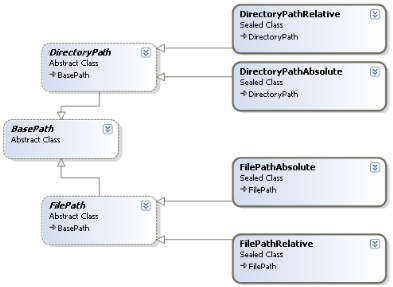
I'll let you go check it out, because you should. I think a class this smart would be a nice addition to the BCL. Here's some of his tests showing the usage of the library. Make careful note of the !'s inside the Asserts. They weren't totally obvious to me. I usually use == false. I find it easier to read.
      //
      // Path string validation
      //
      string reason;
      Debug.Assert(PathHelper.IsValidAbsolutePath(@"C:\Dir2\Dir1", out reason));
      Debug.Assert(!PathHelper.IsValidAbsolutePath(@"C:\..\Dir1", out reason));
      Debug.Assert(!PathHelper.IsValidAbsolutePath(@".\Dir1", out reason));
      Debug.Assert(!PathHelper.IsValidAbsolutePath(@"1:\Dir1", out reason));
      Debug.Assert(PathHelper.IsValidRelativePath(@".\Dir1\Dir2", out reason));
      Debug.Assert(PathHelper.IsValidRelativePath(@"..\Dir1\Dir2", out reason));
      Debug.Assert(PathHelper.IsValidRelativePath(@".\Dir1\..\Dir2", out reason));
      Debug.Assert(!PathHelper.IsValidRelativePath(@".\Dir1\..\..\Dir2", out reason));
      Debug.Assert(!PathHelper.IsValidRelativePath(@"C:\Dir1\Dir2", out reason));
using System;
using System.Collections.Generic;
using System.Linq;
using System.Reflection;
using System.Text;
using Ruby;
using Ruby.Extensions;
using Microsoft.Scripting.Utils;
using Ruby.Runtime;

namespace IronRuby.Library.Scanner {
    static class ExtensionMethods {
        public static IEnumerable<T> SelectCustomAttributes<T>(this Type type) where T : Attribute {
            return type.GetCustomAttributes(typeof(T), false).Cast<T>();
        }

        public static IEnumerable<T> SelectCustomAttributes<T>(this MethodInfo method) where T : Attribute {
            return method.GetCustomAttributes(typeof(T), false).Cast<T>();
        }
    }

    class RubyClassInfo {
        public Type ClrType { get; set; }

        public delegate void Block(IEnumerable<RubyMethodAttribute> methods);

        public string Name {
            get { return ClrType.SelectCustomAttributes<RubyClassAttribute>().First().Name ?? ClrType.Name; }
        }

        private Type LookupExtensionModuleType(IncludesAttribute attr) {
            Type includedType;
            Program.ExtensionModules.TryGetValue(attr.Type, out includedType);
            return includedType ?? attr.Type;
        }

        private void GetMethodNames(Type t, Block accumulate) {
            var methods = (from m in t.GetMethods()
                           where m.IsDefined(typeof(RubyMethodAttribute), false)
                           select m.SelectCustomAttributes<RubyMethodAttribute>().First());

            accumulate(methods);

            foreach (IncludesAttribute attr in t.SelectCustomAttributes<IncludesAttribute>())
                GetMethodNames(LookupExtensionModuleType(attr), accumulate);
        }

        private IEnumerable<string> GetMethodNames(RubyMethodAttributes methodType) {
            var result = new List<string>();
            GetMethodNames(ClrType, methods =>
                result.AddRange((from m in methods
                                 where m.MethodAttributes == methodType
                                 select m.Name).Distinct()));
            result.Sort();
            return result;
        }

        public IEnumerable<string> InstanceMethods {
            get { return GetMethodNames(RubyMethodAttributes.PublicInstance); }
        }

        public IEnumerable<string> SingletonMethods {
            get { return GetMethodNames(RubyMethodAttributes.PublicSingleton); }
        }
    }

    class Program {
        static IEnumerable<RubyClassInfo> GetRubyTypes(Assembly a) {
            return from rci in
                        (from t in a.GetTypes()
                         where t.IsDefined(typeof(RubyClassAttribute), false)
                               && !t.IsDefined(typeof(RubyExtensionModuleAttribute), false)
                         select new RubyClassInfo { ClrType = t })
                   orderby rci.Name
                   select rci;
        }

        static Dictionary<Type, Type> GetExtensionModules(Assembly a) {
            var modules = from t in a.GetTypes()
                          where t.IsDefined(typeof(RubyExtensionModuleAttribute), false)
                          select new { Type = t, Attribute = t.SelectCustomAttributes<RubyExtensionModuleAttribute>().First() };


            var result = new Dictionary<Type, Type>();
            foreach(var m in modules)
                result[m.Attribute.Extends] = m.Type;
            return result;
        }

        const string RubyAssembly = @"Ruby, Version=1.0.0.0, Culture=neutral, PublicKeyToken=31bf3856ad364e35";
        internal static Dictionary<Type, Type> ExtensionModules;

        static void DumpMethods(IEnumerable<RubyClassInfo> types, Func<RubyClassInfo, IEnumerable<string>> getMethods) {
            foreach (RubyClassInfo rci in types) {
                Console.WriteLine("{0}:", rci.Name);
                foreach (string methodName in getMethods(rci))
                    Console.WriteLine("  - {0}", methodName);
            }
        }

        static void Main(string[] args) {
            var name = new AssemblyName(RubyAssembly);
            var a = Assembly.Load(name);

            ExtensionModules = GetExtensionModules(a);
            var types = GetRubyTypes(a);

            DumpMethods(types, t => t.InstanceMethods);
            DumpMethods(types, t => t.SingletonMethods);
        }
    }
}
Feel free to send me any links to cool source you find.
About Scott
Scott Hanselman is a former professor, former Chief Architect in finance, now speaker, consultant, father, diabetic, and Microsoft employee. He is a failed stand-up comic, a cornrower, and a book author.


About Newsletter
Hosting By




The code snippets don't work in Google reader, but I guess it does bring me to your actual site... :)

Yeah your code snippets always look horrible in the RSS. There is also always a big chunk of CSS beneath each code snippet, like this...
.csharpcode, .csharpcode pre {font-size:small;color:black;font-family:consolas, "Courier New", courier, monospace;background-color:#ffffff;} .csharpcode pre {margin:0em;} .csharpcode .rem {color:#008000;} .csharpcode .kwrd {color:#0000ff;} .csharpcode .str {color:#006080;} .csharpcode .op {color:#0000c0;} .csharpcode .preproc {color:#cc6633;} .csharpcode .asp {background-color:#ffff00;} .csharpcode .html {color:#800000;} .csharpcode .attr {color:#ff0000;} .csharpcode .alt {background-color:#f4f4f4;width:100%;margin:0em;} .csharpcode .lnum {color:#606060;}
.csharpcode, .csharpcode pre {font-size:small;color:black;font-family:consolas, "Courier New", courier, monospace;background-color:#ffffff;} .csharpcode pre {margin:0em;} .csharpcode .rem {color:#008000;} .csharpcode .kwrd {color:#0000ff;} .csharpcode .str {color:#006080;} .csharpcode .op {color:#0000c0;} .csharpcode .preproc {color:#cc6633;} .csharpcode .asp {background-color:#ffff00;} .csharpcode .html {color:#800000;} .csharpcode .attr {color:#ff0000;} .csharpcode .alt {background-color:#f4f4f4;width:100%;margin:0em;} .csharpcode .lnum {color:#606060;}

Hi Scott,
If you or your readers are using Windows Live Writer, I have a code formatter plug-in for it at http://stevedunns.blogspot.com/2007/09/new-version-of-code-formatter-plug-in.html
Lanugages include:
* Assembly
* BatchFile
* CSharp
* CSS
* HTML
* INIFile
* Java
* JScript
* Lua (pronounced LOO-ah)
* MSIL
* Pascal
* Perl
* PHP
* PowerShell
* Python
* SQL
* VBDotNet
* VBScript
* XAML
* XML
There's also some source code to read if that takes your fancy!
Cheers,
Steve
If you or your readers are using Windows Live Writer, I have a code formatter plug-in for it at http://stevedunns.blogspot.com/2007/09/new-version-of-code-formatter-plug-in.html
Lanugages include:
* Assembly
* BatchFile
* CSharp
* CSS
* HTML
* INIFile
* Java
* JScript
* Lua (pronounced LOO-ah)
* MSIL
* Pascal
* Perl
* PHP
* PowerShell
* Python
* SQL
* VBDotNet
* VBScript
* XAML
* XML
There's also some source code to read if that takes your fancy!
Cheers,
Steve

Don't forget you can just put Vista in power saver mode when running on batteries and it'll disable all that junk for you. And it'll do all the other things that make your battery last longer.
Interesting - I wonder why he used P/Invoke for the power management stuff. Looks to me like that info is available through managed APIs (SystemEvents, ...)

Apropos John Lam's code snippet - C# is looking like the overly verbose Java with every passing day. There is something to be said for the aesthetics of a language. That's one of the primary reasons I love Ruby.

Comments are closed.
Would be very nice!