Scott Hanselman

Hanselminutes Podcast 186: .NET Debugging 101 with Tess Ferrandez

December 02, 2009 Comment on this post [3] Posted in ASP.NET | Podcast | VS2010
Sponsored By

Tess Ferrandez My one-hundred-and-eighty-sixth podcast is up. I was in Sweden a few weeks and sat down with master debugger and ASP.NET Escalation Engineer Tess Ferrandez. She explains .NET Debugging 101. What's a dump file? Do you need PDBs? How do you use WinDBG and what are the best ways to debug memory issues, perf problems and hangs.

Also check out video of Tess up on Channel 9 as she walks me through new debugging features in VS2010.

Subscribe: Subscribe to Hanselminutes Subscribe to my Podcast in iTunes

Download: MP3 Full Show

Do also remember the complete archives are always up and they have PDF Transcripts, a little known feature that show up a few weeks after each show.

Telerik is our sponsor for this show.

Check out their UI Suite of controls for ASP.NET. It's very hardcore stuff. One of the things I appreciate aboutTelerik is their commitment to completeness. For example, they have a page about their Right-to-Left support while some vendors have zero support, or don't bother testing. They also are committed to XHTML compliance and publish their roadmap. It's nice when your controls vendor is very transparent.

As I've said before this show comes to you with the audio expertise and stewardship of Carl Franklin. The name comes from Travis Illig, but the goal of the show is simple. Avoid wasting the listener's time. (and make the commute less boring)

Enjoy. Who knows what'll happen in the next show?

About Scott

Scott Hanselman is a former professor, former Chief Architect in finance, now speaker, consultant, father, diabetic, and Microsoft employee. He is a failed stand-up comic, a cornrower, and a book author.

facebook bluesky subscribe
About   Newsletter
Hosting By
Hosted on Linux using .NET in an Azure App Service

Screenshots: Amazon Kindle 2 gets Better Battery Life and Native PDF Support

November 24, 2009 Comment on this post [31] Posted in Reviews
Sponsored By

I love my Kindle. I've talked about this before in my quest for the perfect ebook reader:

It's always come down to this. If you want to read PDFs, get a Kindle DX. The screen is larger and it's just better for 8.5x11 or A4 documents. The Kindle 2 is for novels and the DX is for documents. At least, until now.

Today the situation just got a little blurrier. My Kindle 2 has been firmware version 2.0.3 for a while now. However, soon you'll get 2.3 pushed to you over wireless, or you can go get it yourself manually if, like me, you can't wait.

Manually installing is trivial. Download the update, copy it to the root of your Kindle 2 via USB, go to Settings and hit Update Kindle. It'll take about 5-10 minutes.

Not only does the Kindle 2 get a built-in PDF reader, you also get longer battery life. How? Well, I love my Kindle, truly, but it's true that if the 3G radio is on and you forget about it, you'll find a dead Kindle in a few days, usually just before a trip. Nothing more embarrassing than telling the dude in the airline seat next to you that "my book has a dead battery." ;)

The new firmware is smarter about when it turns the radio on and they say: "You can now read for up to 1 week on a single charge with wireless on. Turn wireless off and read for up to 2 weeks." I have yet to test this, but I can say that with the radio off, yes, it'll be on standby for a week or two, easy.

You can also manually rotate the Kindle 2 screen, previously a DX-only feature.

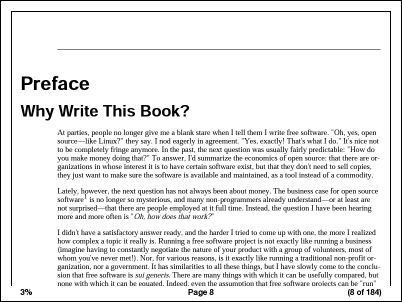
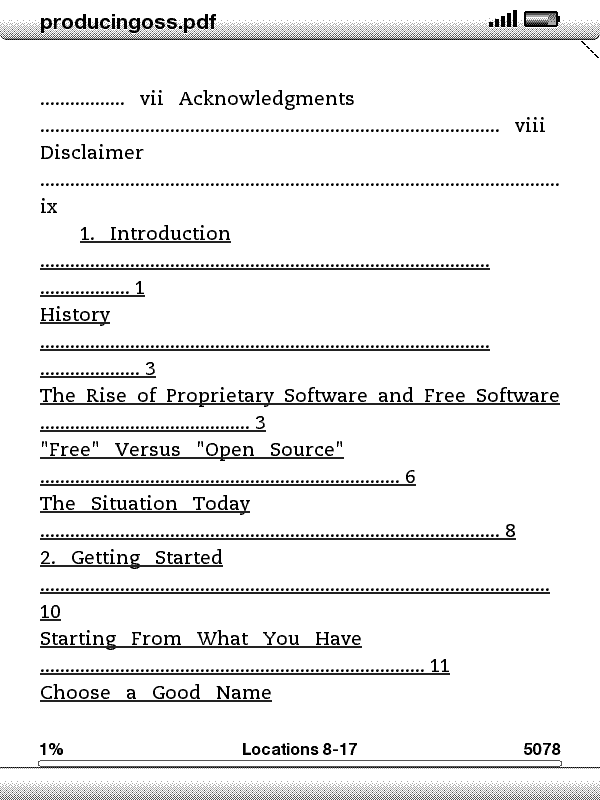
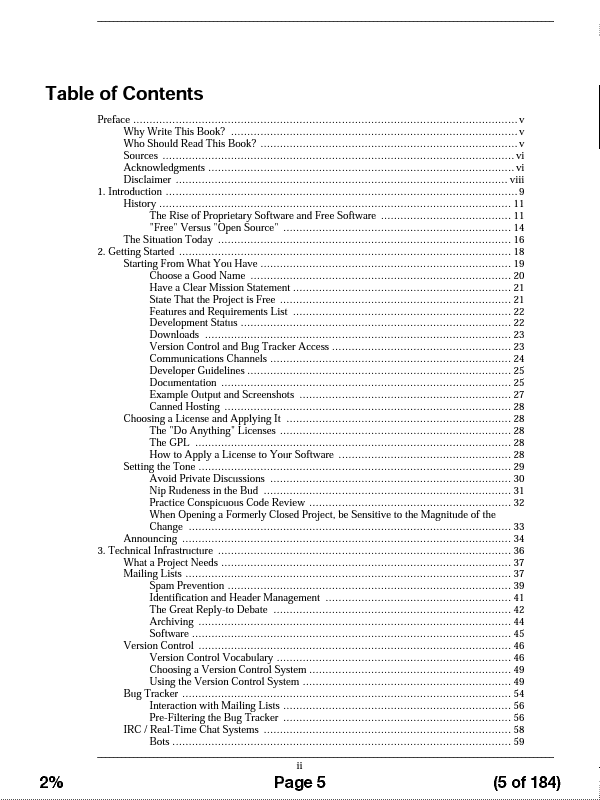
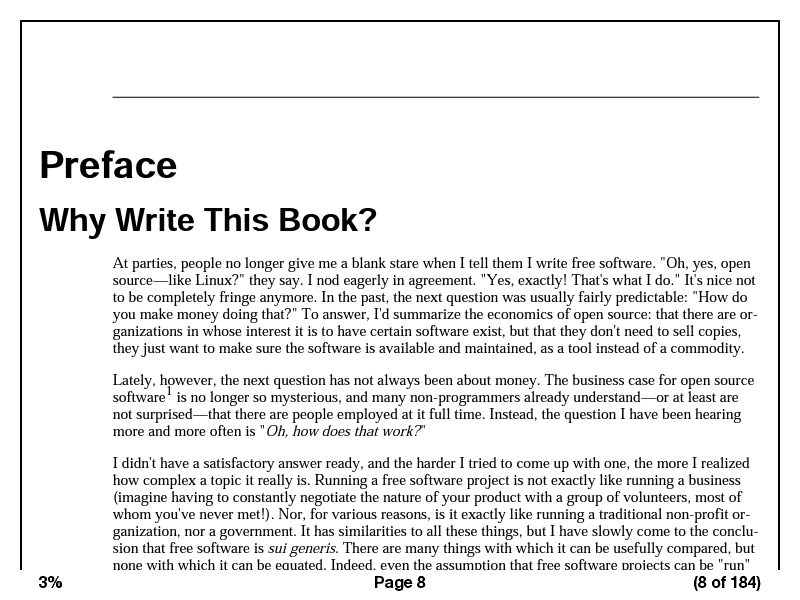
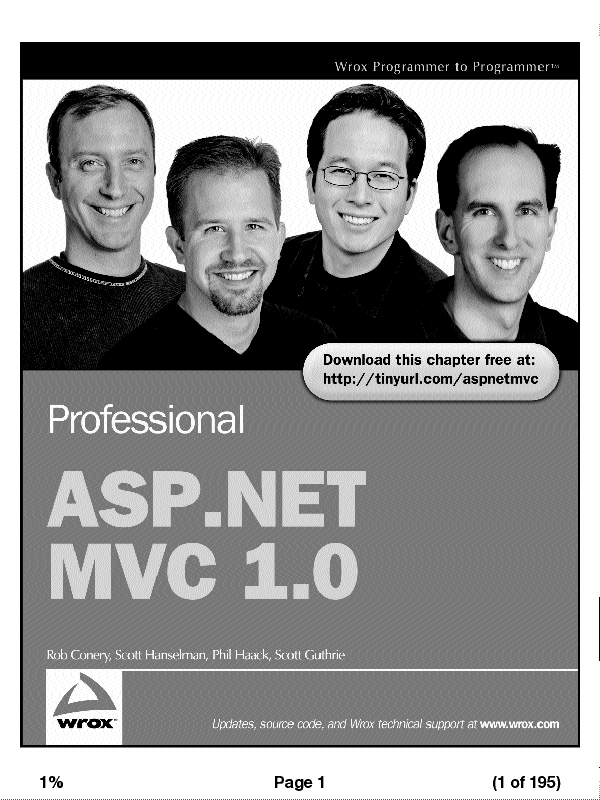
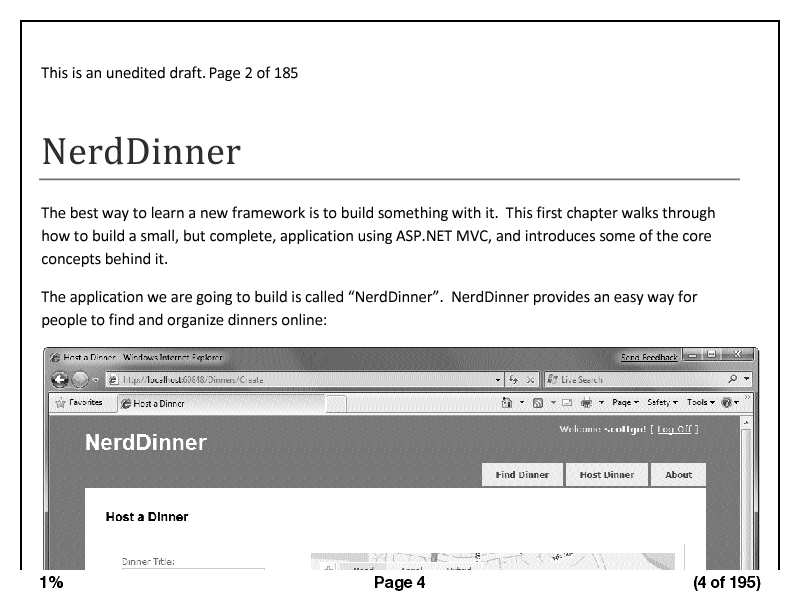
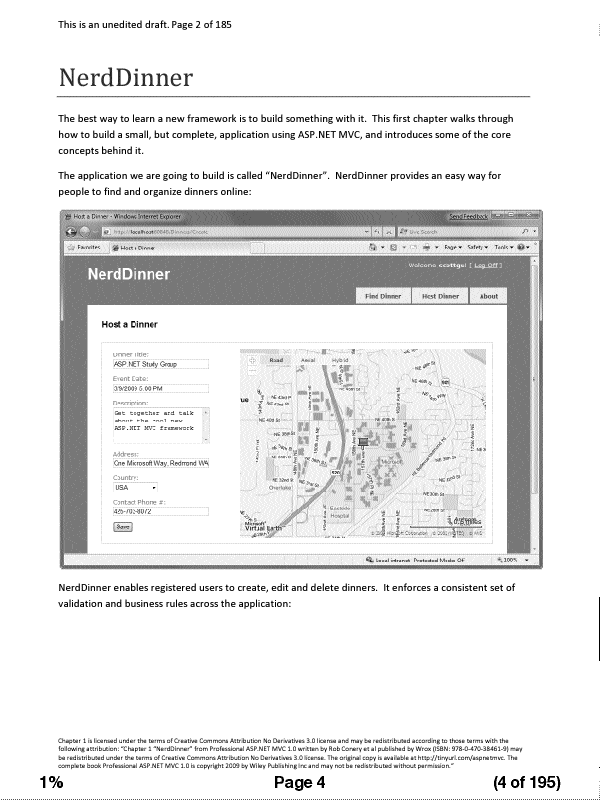
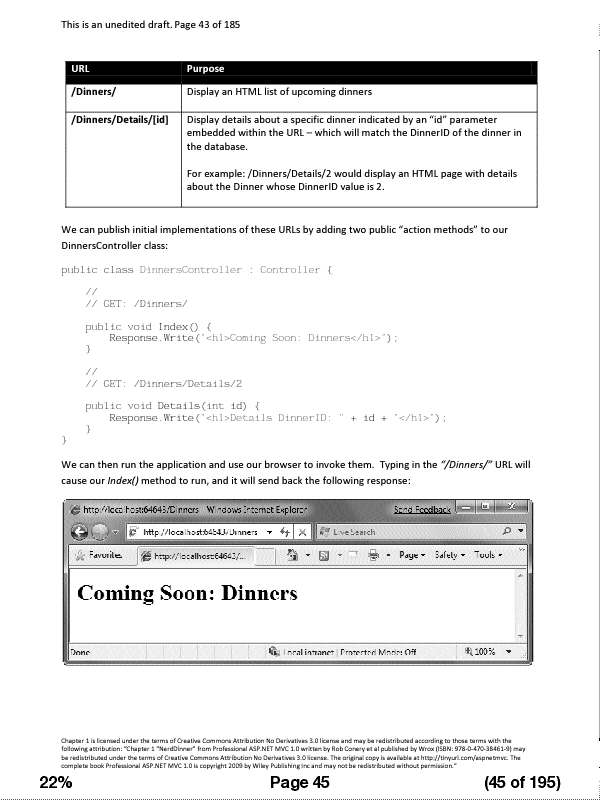
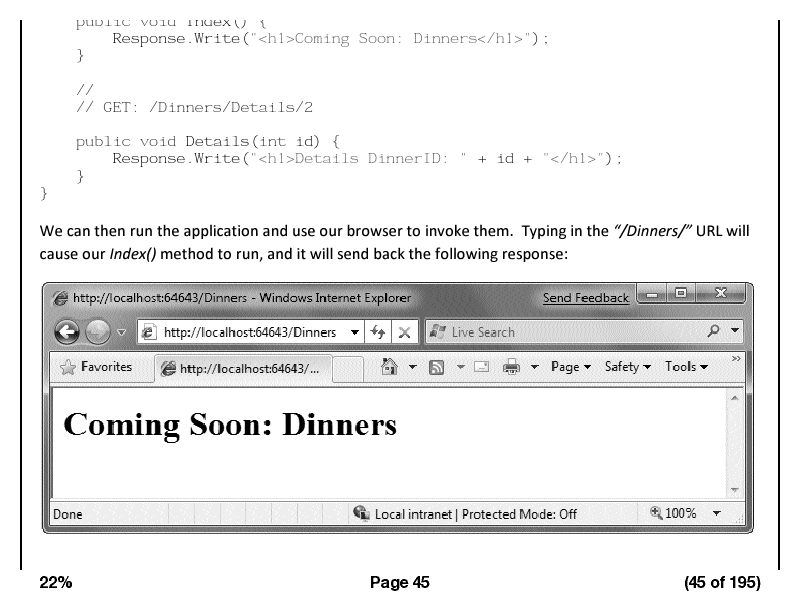
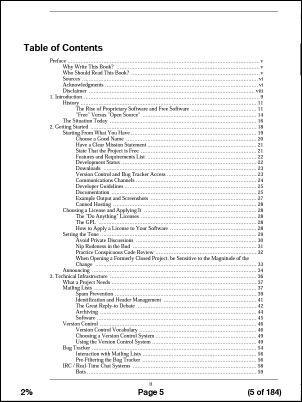
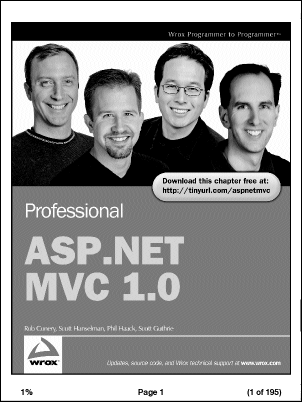
Here's how things look on the Kindle 2 with a PDF using the older firmware, then using the new 2.3 firmware. The first PDF I'm using for A-B testing is "Producing Open Source Software" from http://www.producingoss.com. I also use the free ASP.NET MVC chapter from http://tinyurl.com/aspnetmvc.

Now, a pile of screenshots because there's no other way to get the point across. Forgive me.

NOTE: You can click any of these images to get the FULL 800x600 resolution screenshot directly from my Kindle 2.

Firmware 2.0.3 - a PDF converted by emailing to my Kindle
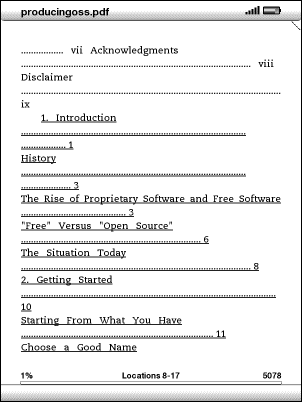
screen_shot-29642

Firmware 2.3 - Same PDF viewed with the Native PDF Viewer
screen_shot-10326 screen_shot-10328

Firmware 2.3 - Wrox Book Cover viewed with the Native PDF Viewer
screen_shot-10322

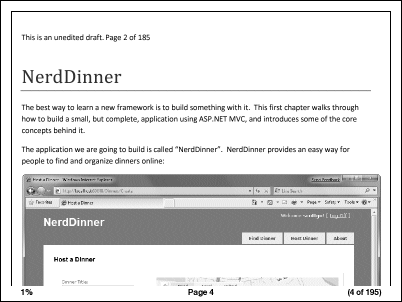
Firmware 2.3 - Wrox Book viewed with the Native PDF Viewer ROTATED
screen_shot-10324

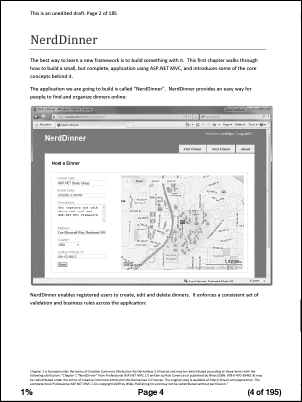
Firmware 2.3 - Wrox Book viewed with the Native PDF Viewer
screen_shot-10323

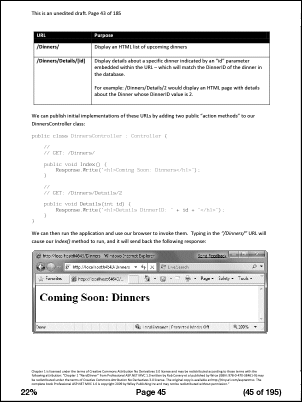
Most importantly, is Code readable? Well, yes and no. It's readable, but it's not comfortable. It depends on the code and on the way the PDF is formatted. In the Wrox PDF example, the code was formatted kind of gray, which doesn't help given the Kindle screen. The important thing to note is that PDF formatting and fonts appear to be respected 100%. If it's clear and readable on your PC, it'll at least be readable on the Kindle, assuming the limitations of the screen hardware.

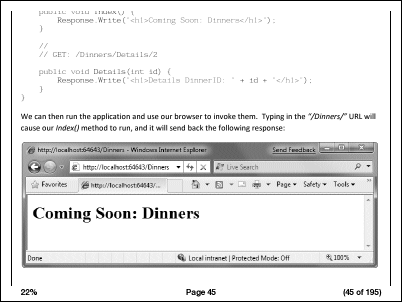
Note that when you rotate the screen (with the font button) that you can see the layout and text more clearly, but you'll only see the top or bottom half of the page. When you hit Prev/Next Page you'll move up and down the page before you actually turn a page. It's not perfect, but it's something.

Firmware 2.3 - Wrox Book with Code and Tables viewed with the Native PDF Viewer
 screen_shot-10329

Firmware 2.3 - Wrox Book with Code and Tables viewed with the Native PDF Viewer ROTATED
screen_shot-10330

Conclusion

For a standard A4 or 8.5x11" page, it's not really easy to read on a 3.6 in (91 mm) × 4.8 in screen. Expect to read PDFs rotated.

Your Kindle 2 just got a new lease on life. This is totally new, free functionality for your Kindle 2. It's now a competent PDF reader. If you're a coder or a PDF reader, be thrilled. Now go get it.

About Scott

Scott Hanselman is a former professor, former Chief Architect in finance, now speaker, consultant, father, diabetic, and Microsoft employee. He is a failed stand-up comic, a cornrower, and a book author.

facebook bluesky subscribe
About   Newsletter
Hosting By
Hosted on Linux using .NET in an Azure App Service

Oredev Keynote - Information Overload and Managing the Flow: Effectiveness and Efficiency

November 23, 2009 Comment on this post [12] Posted in Speaking | Tools
Sponsored By

I am by no means an expert on being effective or doing things efficiently, but I do OK and I get some stuff done. Most importantly, I think, I am attempting at least to be conscious as I do work.

Recently I was in Malmo, Sweden presenting at the Øredev conference. I presented this keynote as well as a talk on ASP.NET MVC 2 and also did a few panels, one of which we recorded LIVE and streamed online.

Here's my talk from that Friday keynote. I include links to each of the Creative Commons photos I used from Flickr, as well as links to each of the web pages where I did my research or where I used a diagram. I also tried to call out each place where the thoughts were not mine.

This talk is/was a mashup of the various techniques that I try to apply in my everyday life. There's a little GTD, a little Covey, a little Pomodoro, a little Jon Udell, a little 43 Folders, a little Merlin Mann, a little Gina Trapani, and a little Hanselman. I also show some of the tools I used to manage the flow of information in my life. I hope you enjoy it. I'm  pretty happy with the way it turned out, given that I was freaking out about it for a week.

You can watch the talk in HD here, or if you're viewing this page from hanselman.com directly, you can watch it embedded below. The sound is a little hot (it's overdriven by the sound guy) so please forgive us.

Scott Hanselman - Information Overload and Managing the Flow from Øredev on Vimeo.

About Scott

Scott Hanselman is a former professor, former Chief Architect in finance, now speaker, consultant, father, diabetic, and Microsoft employee. He is a failed stand-up comic, a cornrower, and a book author.

facebook bluesky subscribe
About   Newsletter
Hosting By
Hosted on Linux using .NET in an Azure App Service

Our little team is growing - Welcome to Jon Galloway and Pete Brown

November 12, 2009 Comment on this post [17] Posted in ASP.NET | ASP.NET MVC | Microsoft | Win7 | Windows Client
Sponsored By
stoninja

Just about two years ago I joined Microsoft. I'm fortunate to work in a home office with a great team that I now lead. We work for the group at Microsoft that runs MSDN, TechNet, ASP.NET, Silverlight.NET, WindowsClient.NET, basically all the online education stuff. The giant group is called STO (Server & Tools Online) and our little group is "stoninja." That's our internal mailing alias.

We create content for all of the sites above but we're also active members of the community. We listen and drive feedback back into the product group. We're not part of the product evangelism group (DPE - Developer Platform Evangelism), but rather we focus primarily on online content creation. I like to think that we're the team that happens you after you go File|New Project, although we're constantly influencing what happens on both sides.

Fast forward to today and my little team is growing.

jon gallowayI'd like to announce that Jon Galloway is joining my team, he's coming to work for us via our good friends at Vertigo (who just announced a new Vertigo Software - Portland office which is cool). It's a bit of a change for Jon and it's something he's always wanted to do. Jon's official title will be Community Program Manager but I like to think of each member of the team as a Community Liaison. We're a small group, but we're sneaky (like ninjas, just fat, middle-aged somewhat pasty ninjas) and we are continually applying pressure to what we think are the right places within Microsoft.

You might know Jon from the Herding Code podcast he does with K. Scott Allen, Kevin Dente and Scott Koon. You might have read the ASP.NET 2.0 Anthology book that he worked on with Jeff, Phil, K. Scott and Wyatt. Jon's also done open source and works on SubText. Jon will be focusing on ASP.NET (all of it). He'll help get the http://asp.net site in shape and provide a much needed pragmatic view of all things web.

petebrown Also joined just a few weeks ago is Pete Brown. Pete comes to us after a long stint as .NET Architect, Project Manager, and Client Technologies Evangelist at Applied Information Sciences (AIS).

You may know Pete from his amazing C64 Emulator port to Silverlight. Pete has been working on the WindowsClient.NET site creating content and code samples that show some of the cool stuff you can do in Windows 7. He's started a multi-part video series just recently on the Windows 7 Sensor and Location APIs and will be filling the Learn section with even more great videos as well as working on http://msdn.com/windows.

When I came to work at Microsoft I posted a Venn diagram that looked like this:

I hope Jon and Pete's personal Venn diagram looks like mine, or since they are working from home (my whole team is remote) perhaps like this one ;)

Venn - Times when Happy vs. Times when wearing Pants

Please welcome both Jon and Pete to the team! The whole team - Me, Joe, Jesse, Tim, Pete and Jon - will be at PDC this year so do stop us and say Hello if you're there!

About Scott

Scott Hanselman is a former professor, former Chief Architect in finance, now speaker, consultant, father, diabetic, and Microsoft employee. He is a failed stand-up comic, a cornrower, and a book author.

facebook bluesky subscribe
About   Newsletter
Hosting By
Hosted on Linux using .NET in an Azure App Service

Download Podcasts with Powershell

November 09, 2009 Comment on this post [10] Posted in Podcast | PowerShell
Sponsored By

A number of people have mentioned to me that they didn't realize that Powershell is included by default in Windows 7. If you haven't yet jumped on the Powershell bandwagon, this is a good time. Powershell 2 includes a bunch of cool features like remoting (kind of like SSH) as well as a visual IDE for writing, editing and interactively debugging Powershell scripts.

Windows PowerShell ISE (2)

Powershell great for system administration, but I mostly use it for quick and dirty "portable" apps that I don't feel like writing C#/VB for. Plus, I'm using .NET anyway, so it's all the same.

I wanted to download all my podcasts with Powershell, so I wrote this quick script in about 5 minutes. Other improvements I (or preferably you) could make to it could be: check the file size against the enclosure and re-download partials, rename the files to included a version of the title, include a progress bar.

Here's what I came up with. Perhaps you'll find it useful if you're not an iTunes/Zune person:

cd "C:\users\scottha\desktop\Hanselminutes Complete Download"
[Environment]::CurrentDirectory=(Get-Location -PSProvider FileSystem).ProviderPath
$a = ([xml](new-object net.webclient).downloadstring("http://feeds.feedburner.com/HanselminutesCompleteMP3"))
$a.rss.channel.item | foreach{
$url = New-Object System.Uri($_.enclosure.url)
$file = $url.Segments[-1]
$file
if (!(test-path $file))
{
(New-Object System.Net.WebClient).DownloadFile($url, $file)
}
}

Of course you'll want to change the first line and the RSS Feed URL as you like.

Hanselminutes Complete Download

If you've never used Powershell before, note that it's locked down from running scripts be default. You'll need to run it as Administrator once and run

Set-ExecutionPolicy unrestricted

This opens it up to run scripts, but it's not only VBS, the scripts won't run if you double-click them. You need to run powershell then type the name of your script to run it:

.\myscript.ps1

You can always set the execution policy back if it bothers you.

Hope this primitive mass podcast enclosure downloader is useful.

About Scott

Scott Hanselman is a former professor, former Chief Architect in finance, now speaker, consultant, father, diabetic, and Microsoft employee. He is a failed stand-up comic, a cornrower, and a book author.

facebook bluesky subscribe
About   Newsletter
Hosting By
Hosted on Linux using .NET in an Azure App Service

Disclaimer: The opinions expressed herein are my own personal opinions and do not represent my employer's view in any way.