ScottGu MVC Presentation and ScottHa Screencast from ALT.NET Conference
I attended the ALT.NET Conference last weekend in Austin, TX. I personally find the name "Alt" as in "Alternative" too polarizing and prefer terms like "Pragmatic.NET" or "Agile.NET." At the conference I suggested, partially in jest, that we call it "NIH.NET" as in "Not Invented Here.NET." ;)
Ultimately this is a group that believes in:
- Continuous Learning
- Being Open to Open Source Solutions
- Challenging the Status Quo
- Good Software Practices
- DRY (Don't Repeat Yourself)
- Common Sense when possible
I asked "Why is this alternative," and Martin Fowler echoed those sentiments. When I was at Corillian we were using NAnt, NUnit, Subversion, NCover, NDoc, NDepend, CruiseControl, Watir/Watin and Ruby and we practiced Scrum with an Agile Coach. Did that make us alternative or were we just getting the job done? We made practical and pragmatic decisions and it worked out OK.
Whether this is Alternative .NET or just Practical .NET, it's a conversation and that's a a good thing.
 ScottGu gave an hour long presentation on the upcoming MVC Framework and I took some guerilla video. ScottGu's presentation is here in Silverlight and it's about 60 minutes long. Considering it's so long, the video squished nicely.
This was the first time the MVC Framework was shown publicly. Note that this was a Prototype, not the Production code and both ScottGu and I make that point a number of times to drive home that it's early. Some of the code was written on a plane, just to give you an idea.
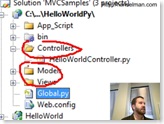
After The Gu did his piece on the MVC Framework, I showed some prototype hacking that I'd done over the previous few days along with some work Phil Haack did. My presentation is here as Silverlight and it's about 30 minutes long. I showed the Model View Controller with Controllers in IronPython and an IronPython view using a WebFormViewEngine. Then I talked about the possibilities of alternate ViewEngines and showed Phil Haack's prototype RubyViewEngine.
Both talks show lots of code. Of course, this is prototype madness. No warranty, express or implied. Features come and go, but I hope this shows that we're committed to aiming for as much awesomeness as is humanly possible. I hope you enjoy them, even though my webcam hand was shaky after an hour. I used a new Microsoft NX-7000 Lifecam for the recoding - it's a great camera for the Alpha Geek. ;)
Here's the videos I promised:
- ScottGu on MVC at ALT.NET Conference (60min-ish)
- ScottHa on MVC+DLR=Love at ALT.NET Conference (30min-ish)
If you want to link to these, link to this post, not those links, as the videos might move around. Thanks.
Here's some of the buzz around the new Framework. I hope this framework is a harbinger of things to come in future frameworks.
- Chris Holmes: ALT.NET Conference: Brave New World
- Roy Osherove - Microsoft gets Design For Testability with new MVC framework for ASP.NET- Finally.
- Jeffery Palermo - Scott Guthrie announces ASP.NET MVC framework at Alt.Net Conf
- Nima Dilmaghani - Microsoft announces new MVC architecture for Web Apps
- Gary Sherman - Microsoft is changing the world - at least part of my world - for the better and MVC Framework
- Rod Paddock - AltNetConf Day2 - Agile and MVC Goodness
Things are looking up.
About Scott
Scott Hanselman is a former professor, former Chief Architect in finance, now speaker, consultant, father, diabetic, and Microsoft employee. He is a failed stand-up comic, a cornrower, and a book author.


About Newsletter

_thumb.png) Just a reminder if you're in Portland or SW Washington that now is the time to register for the
Just a reminder if you're in Portland or SW Washington that now is the time to register for the 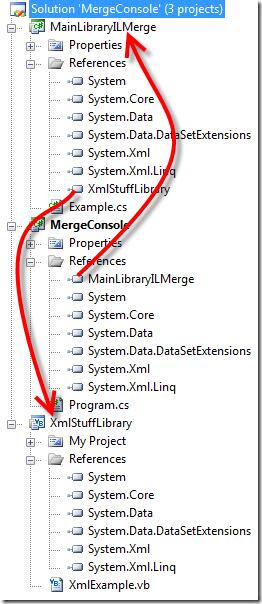 What I really want is to be able to mark an assembly as merge-able and have it automatically merged in just because it's referenced.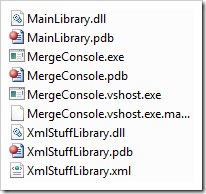
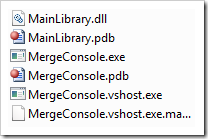
 Crap. Now what?