You likely know that open source .NET Core is cross platform and it's super easy to do "Hello World" and start writing some code.
You just install .NET Core, then "dotnet new console" which will generate a project file and basic app, then "dotnet run" will compile and run your app? The 'new' command will create all the supporting code, obj, and bin folders, etc. When you do "dotnet run" it actually is a combination of "dotnet build" and "dotnet exec whatever.dll."
What could be easier?
What about .NET Core as scripting?
Check out dotnet script:
C:\Users\scott\Desktop\scriptie> dotnet tool install -g dotnet-script You can invoke the tool using the following command: dotnet-script C:\Users\scott\Desktop\scriptie>copy con helloworld.csx Console.WriteLine("Hello world!"); ^Z 1 file(s) copied. C:\Users\scott\Desktop\scriptie>dotnet script helloworld.csx Hello world!
NOTE: I was a little tricky there in step two. I did a "copy con filename" to copy from the console to the destination file, then used Ctrl-Z to finish the copy. Feel free to just use notepad or vim. That's not dotnet-script-specific, that's Hanselman-specific.
Pretty cool eh? If you were doing this in Linux or OSX you'll need to include a "shebang" as the first line of the script. This is a standard thing for scripting files like bash, python, etc.
Even better! Once you have "dotnet-script" installed as a global tool as above:
dotnet tool install -g dotnet-script
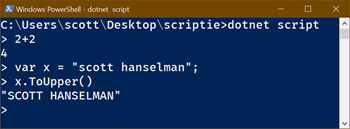
You can use it as a REPL! Finally, the C# REPL (Read Evaluate Print Loop) I've been asking for for only a decade! ;)
C:\Users\scott\Desktop\scriptie>dotnet script > 2+2 4 > var x = "scott hanselman"; > x.ToUpper() "SCOTT HANSELMAN"
This is super useful for a learning tool if you're teaching C# in a lab/workshop situation. Of course you could also learn using http://try.dot.net in the browser as well.
In the past you may have used ScriptCS for C# scripting. There's a number of cool C#/F# scripting options. This is certainly not a new thing:
In this case, I was very impressed with the easy of dotnet-script as a global tool and it's simplicity. Go check out https://github.com/filipw/dotnet-script and try it out today!
Sponsor: Check out the latest JetBrains Rider with built-in spell checking, enhanced debugger, Docker support, full C# 7.3 support, publishing to IIS and more advanced Unity support.
About Scott
Scott Hanselman is a former professor, former Chief Architect in finance, now speaker, consultant, father, diabetic, and Microsoft employee. He is a failed stand-up comic, a cornrower, and a book author.
To be frank, historically Ubuntu has sucked on Window's Hyper-V. If you wanted to get a higher (read: usable) resolution it would take a miracle. If you wanted shared clipboards or shared disk drives, well, again, miracle or a ton of manual set up. It's possible but it's not fun.
Why can't it be easy? Well, it is. I installed the Windows 10 "Fall Creators Update" - yes the name is stupid. It's Windows 10 "1809" - that's 2018 and the 9th month. Just type "Winver" from the Start menu. You may have "1803" from March. Go update.
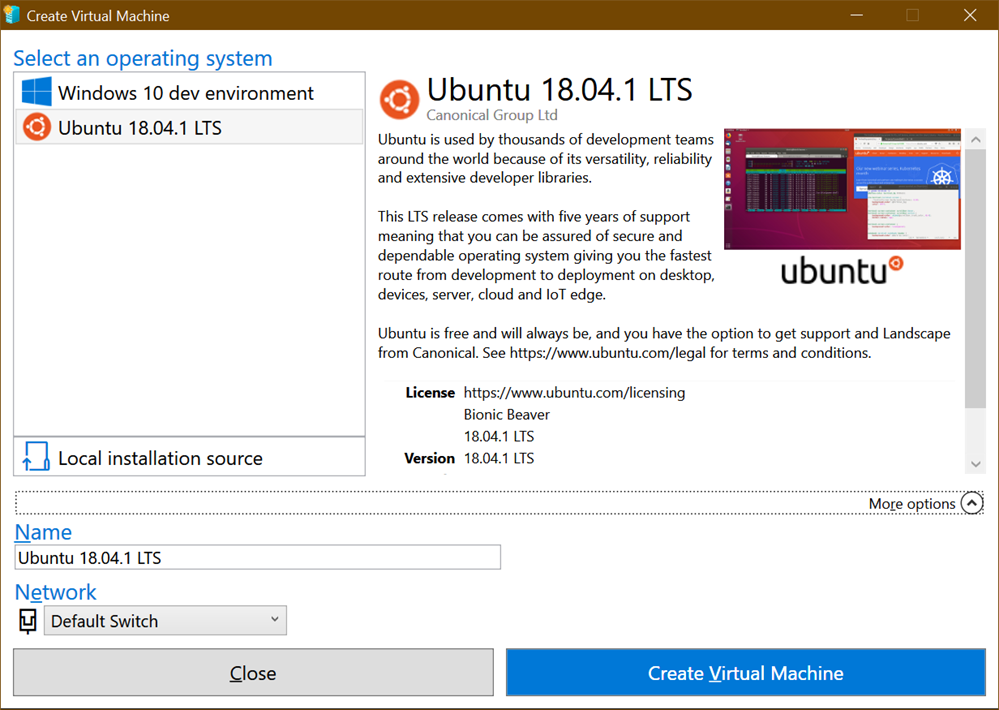
Windows 10 includes Hyper-V Quick Create which has this suspiciously short list under "Select an operating system." Anytime a list has 1 or 2 items and some whitespace that means it will someday have n+1 list items.
Recently Ubuntu 18.04.1 LTS showed up in this list. You can quickly and easily create an Ubuntu VM from here and it's all handled, downloading, network switch, VM create, etc.
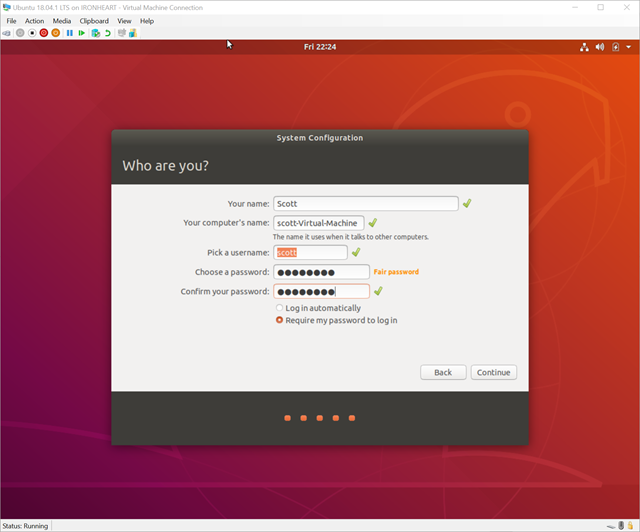
I dig it. So click create, start it up...get to the set up screen. Now, here, make sure you click "Require my password to login." What we want to do won't work with "Log in Automatically" and you don't want that anyway.
After you've created your VM and got it mostly setup, close the Hyper-V client window. Just X it out. The VM is still running of course.
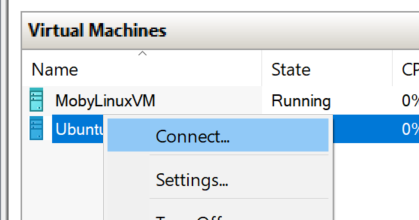
Go over to Hyper-V Manager and right click on it and "Connect."
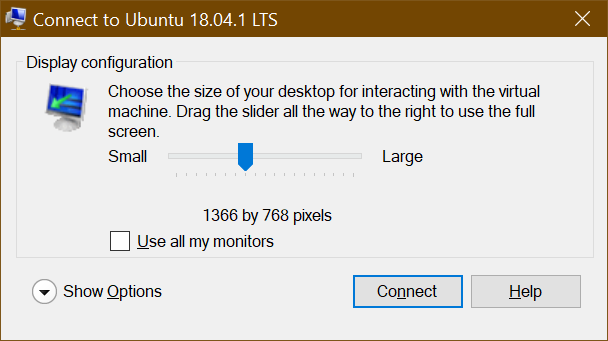
You'll see a resolution dialog...pick one! Go crazy! Do be aware that there are issues on 4k display but you can adjust within Ubuntu itself.
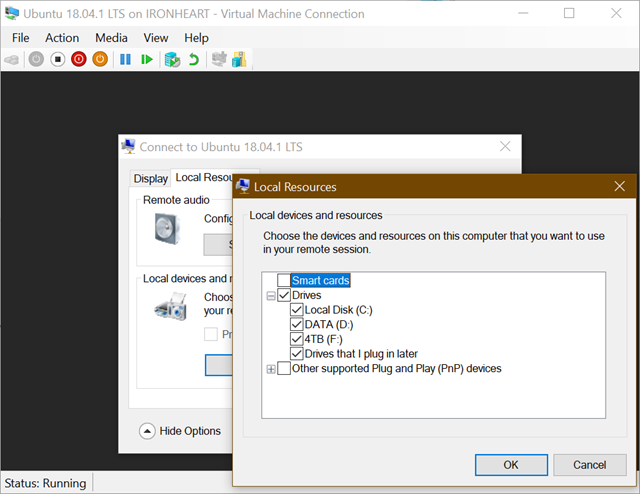
Now, BEFORE you click Connect, click "Show Options" and then "Local Resources." Under here, uncheck Smart Cards and Check "Drives."
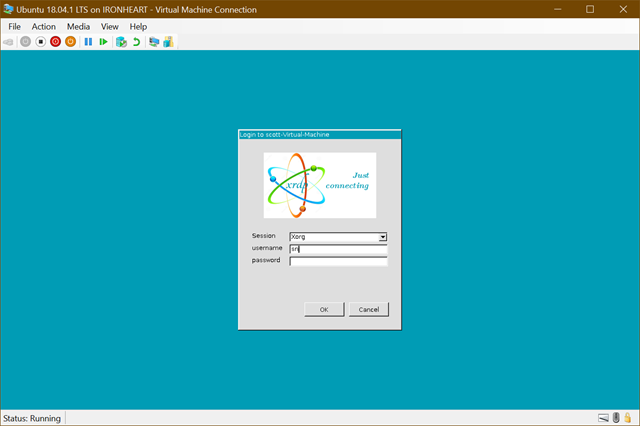
Click OK and Connect...and you get this weird dialog! You're actually RDP'ing into Ubuntu! Rather than using the historical weird Hyper-V Client stuff to talk to Ubuntu and struggle with video cards and resolutions, here you are literally just Remote Desktoping into Ubuntu using integrated open source xrdp!
Login with your name and password (remember before when I said don't automatically login? This is why.)
What about Dynamic Resizing?
Here's an even better possible future. What we REALLY want (don't we, Dear Reader) is Dynamic Resolution and Resizing without Reconnection! Today you can just close and reconnect to change resolutions but I'd love to just resize the Ubuntu window like I do Windows 7/8/10 VM client windows.
The feature "Dynamic resolution update" was introduced in RDP 8.1. It enables to resize screen resolution on-the-fly.
Since we are using xrdp and that's open source over https://github.com/neutrinolabs/xrdp/ AND there's even a issue about this AND a lovely person has the code in their own branch and agreed to possibly upstream it maybe we can start using it and this great feature will just light up for folks who use Hyper-V Quick Create. Certainly we're talking weeks and months here (unless you want to help) but the lion's share of the work is done. I'm looking forward to resizing Ubuntu VMs dynamically.
What's in Enhanced Mode Today?
Back to today! You can read about how Linux VMs (Ubuntu or Arch) are set up in this GitHub repo https://github.com/Microsoft/linux-vm-tools You can set them up yourself with scripts, but the nice thing about Hyper-V Quick Create is that the work is done for us to make these "enhanced session" RDP-friendly VMs. No need to fear, you can just read the scripts yourself.
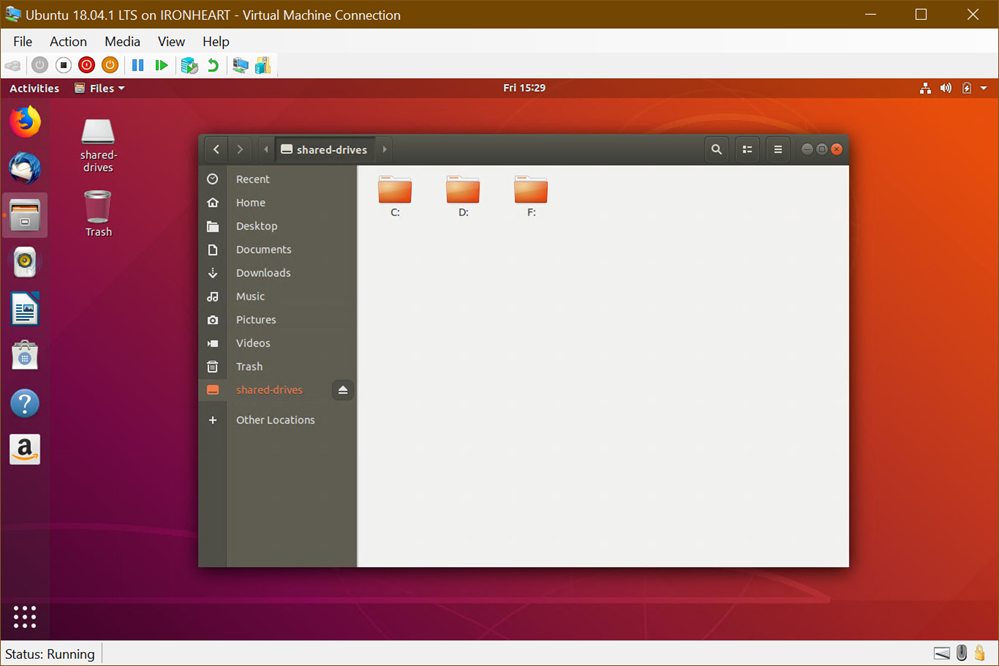
I can connect quickly and Enhanced Mode VMs give me:
This took like 10 min and 8 of it was waiting for Hyper-V Create to download Ubuntu. Try it out!
Sponsor: Check out the latest JetBrains Rider with built-in spell checking, enhanced debugger, Docker support, full C# 7.3 support, publishing to IIS and more advanced Unity support.
About Scott
Scott Hanselman is a former professor, former Chief Architect in finance, now speaker, consultant, father, diabetic, and Microsoft employee. He is a failed stand-up comic, a cornrower, and a book author.
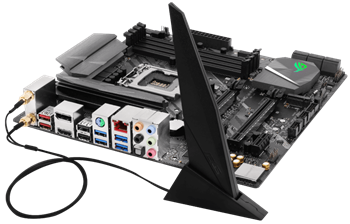
ASUS ROG STRIX LGA2066 X299 ATX Motherboard - Good solid board with built in BT and Wifi, an M.2 heatsink included, 3x PCIe 3.0 x16 SafeSlots (supports triple @ x16/x16/x8), 1x PCIe 3.0 x4, 2x PCIe 3.0 x1 and a Max of 128 gigs of RAM. It also has 8x USB 3.1s and a USB C which is nice.
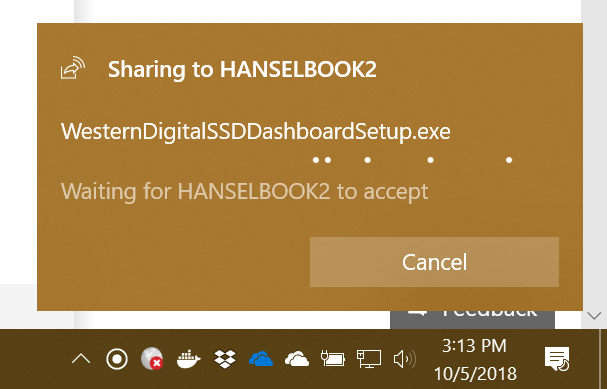
I put it all together and I've thrilled with the machine. However, recently I was trying to use the new Windows 10 "Nearby Devices" feature.
It's this cool feature that lets you share stuff to "Nearby Devices" - that means your laptop, other desktops, whatever. Similar to AirDrop, it solves that problem of moving stuff between devices without using an intermediate server.
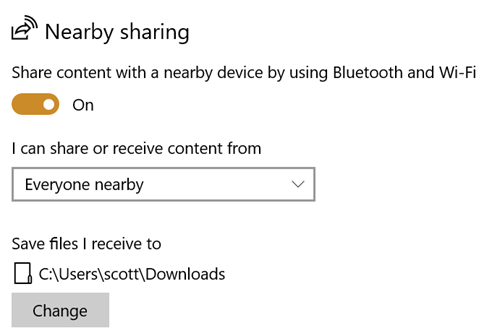
You can turn it on in Settings on Windows 10 and decide if you want to receive data from everyone or just contacts.
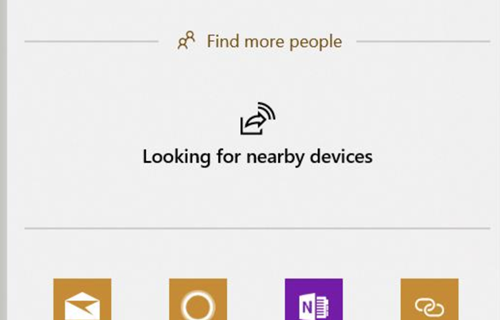
So I started using on my new Desktop, IRONHEART, but I kept getting this "Looking for nearby devices" dialog...and it would just do nothing.
It turns out that the ASUS Motherboard also comes with a Wi-Fi Antenna. I don't use Wifi (I'm wired) so I didn't bother attaching it. It seems that this antenna is also a Bluetooth antenna and if you plug it in you'll ACTUALLY GET A LOVELY BLUETOOTH SIGNAL. Who knew? ;)
Now I can easily right click on files in Explorer or Web Pages in Edge and transfer them between systems.
A few tips on Nearby Sharing
Make sure you know your visibility settings. From the Start Menu type "nearby sharing" and confirm them.
Make sure the receiving device doesn't have "Focus Assist" on (via the Action Center in the lower right of the screen) or you might miss the notification.
And if you're using a desktop like me, ahem, plug in your BT antenna
Hope this helps someone because Nearby Sharing is a great feature that I'm now using all the time.
Sponsor:Telerik DevCraft is the comprehensive suite of .NET and JavaScript components and productivity tools developers use to build high-performant, modern web, mobile, desktop apps and chatbots. Try it!
About Scott
Scott Hanselman is a former professor, former Chief Architect in finance, now speaker, consultant, father, diabetic, and Microsoft employee. He is a failed stand-up comic, a cornrower, and a book author.
I'm sure I'll miss some, so if I do, please sound off in the comments and I'll update this post over the next week or so!
Lately I've been noticing a lot of "Headless" CMSs (Content Management System). A ton, in fact. I wanted to explore this concept and see if it's a fad or if it's really something useful.
Given the rise of clean RESTful APIs has come the rise of Headless CMS systems. We've all evaluated CMS systems (ones that included both front- and back-ends) and found the front-end wanting. Perhaps it lacks flexibility OR it's way too flexible and overwhelming. In fact, when I wrote my podcast website I considered a CMS but decided it felt too heavy for just a small site.
I could start with a database but what if I started with a CMS that was just a backend - a headless CMS. I'll handle the front end, and it'll handle the persistence.
Here's what I found when exploring .NET Core-based Headless CMSs. One thing worth noting, is that given Docker containers and the ease with which we can deploy hybrid systems, some of these solutions have .NET Core front-ends and "who cares, it returns JSON" for the back-end!
Lyncicon is literally implemented as a NuGet Library! It stores its data as structured JSON. It's built on top of ASP.NET Core and uses MVC concepts and architecture.
It does include a front-end for administration but it's not required. It will return HTML or JSON depending on what HTTP headers are sent in. This means you can easily use it as the back-end for your Angular or existing SPA apps.
Lyncion is largely open source at https://github.com/jamesej/lyniconanc. If you want to take it to the next level there's a small fee that gives you updated searching, publishing, and caching modules.
ButterCMS is an API-based CMS that seamlessly integrates with ASP.NET applications. It has an SDK that drops into ASP.NET Core and also returns data as JSON. Pulling the data out and showing it in a few is easy.
public class CaseStudyController : Controller
{
private ButterCMSClient Client;
private static string _apiToken = "";
public CaseStudyController()
{
Client = new ButterCMSClient(_apiToken);
}
[Route("customers/{slug}")]
public async Task<ActionResult> ShowCaseStudy(string slug)
{
var json = await Client.ListPageAsync("customer_case_study", slug)
dynamic page = ((dynamic)JsonConvert.DeserializeObject(json)).data.fields;
ViewBag.SeoTitle = page.seo_title;
ViewBag.FacebookTitle = page.facebook_open_graph_title;
ViewBag.Headline = page.headline;
ViewBag.CustomerLogo = page.customer_logo;
ViewBag.Testimonial = page.testimonial;
return View("Location");
}
}
Then of course output into Razor (or putting all of this into a RazorPage) is simple:
Butter is a little different (and somewhat unusual) in that their backend API is a SaaS (Software as a Service) and they host it. They then have SDKs for lots of platforms including .NET Core. The backend is not open source while the front-end is https://github.com/ButterCMS/buttercms-csharp.
Piranha CMS is built on ASP.NET Core and is open source on GitHub. It's also totally package-based using NuGet and can be easily started up with a dotnet new template like this:
dotnet new -i Piranha.BasicWeb.CSharp
dotnet new piranha
dotnet restore
dotnet run
It even includes a new Blog template that includes Bootstrap 4.0 and is all set for customization. It does include optional lightweight front-end but you can use those as guidelines to create your own client code. One nice touch is that Piranha also includes image resizing and cropping.
The main ASP.NET website currently uses Umbraco as its CMS. Umbraco is a well-known open source CMS that will soon include a Headless option for more flexibility. The open source code for Umbraco is up here https://github.com/umbraco.
Orchard is a CMS with a very strong community and fantastic documentation. Orchard Core is a redevelopment of Orchard using open source ASP.NET Core. While it's not "headless" it is using a Decoupled Architecture. Nothing would prevent you from removing the UI and presenting the content with your own front-end. It's also cross-platform and container friendly.
"Squidex is an open source headless CMS and content management hub. In contrast to a traditional CMS Squidex provides a rich API with OData filter and Swagger definitions." Squidex is build with ASP.NET Core and the CQRS pattern and works with both Windows and Linux on today's browsers.
[Route("/{slug},{id}/")]
public async Task<IActionResult> Post(string slug, string id)
{
var post = await apiClient.GetBlogPostAsync(id);
var vm = new PostVM
{
Post = post
};
return View(vm);
}
What .NET Core Headless CMSs did I miss? Let me know.
This definitely isn't a fad. It makes a lot of sense to me architecturally. Given the proliferation of "backend as a service" systems, DocumentDBs like Cosmos and Mongo, it follows that a headless CMS could easily fit into my systems. One less DB schema to think about, no need to roll my own auth/auth.
Sponsor:Telerik DevCraft is the comprehensive suite of .NET and JavaScript components and productivity tools developers use to build high-performant, modern web, mobile, desktop apps and chatbots. Try it!
About Scott
Scott Hanselman is a former professor, former Chief Architect in finance, now speaker, consultant, father, diabetic, and Microsoft employee. He is a failed stand-up comic, a cornrower, and a book author.
According to https://github.com/dotnet/sourcelink, SourceLink "enables a great source debugging experience for your users, by adding source control metadata to your built assets."
Sounds fantastic. I download a NuGet to use something like Json.NET or whatever all the time, I'd love to be able to "Step Into" the source even if I don't have laying around. Per the GitHub, it's both language and source control agnostic. I read that to mean "not just C# and not just GitHub."
Visual Studio 15.3+ supports reading SourceLink information from symbols while debugging. It downloads and displays the appropriate commit-specific source for users, such as from raw.githubusercontent, enabling breakpoints and all other sources debugging experience on arbitrary NuGet dependencies. Visual Studio 15.7+ supports downloading source files from private GitHub and Azure DevOps (former VSTS) repositories that require authentication.
Looks like Cameron Taggart did the original implementation and then the .NET team worked with Cameron and the .NET Foundation to make the current version. Also cool.
Let me see if this really works and how easy (or not) it is.
I'll put this on GitHub, so I will include "PublishRepositoryUrl" and "EmbedUntrackedSources" as well as including the PDBs. So far my CSPROJ looks like this:
D:\github\SourceLinkTest\PsuedoizerCore [master ≡]> dotnet pack -c release Microsoft (R) Build Engine version 15.8.166+gd4e8d81a88 for .NET Core Copyright (C) Microsoft Corporation. All rights reserved.
Restoring packages for D:\github\SourceLinkTest\PsuedoizerCore\PsuedoizerCore.csproj... Generating MSBuild file D:\github\SourceLinkTest\PsuedoizerCore\obj\PsuedoizerCore.csproj.nuget.g.props. Restore completed in 96.7 ms for D:\github\SourceLinkTest\PsuedoizerCore\PsuedoizerCore.csproj. PsuedoizerCore -> D:\github\SourceLinkTest\PsuedoizerCore\bin\release\netstandard2.0\PsuedoizerCore.dll Successfully created package 'D:\github\SourceLinkTest\PsuedoizerCore\bin\release\PsuedoizerCore.1.0.0.nupkg'.
Let's look inside the .nupkg as they are just ZIP files. Ah, check out the generated *.nuspec file that's inside!
See under repository it points back to the location AND commit hash for this binary! That means I can give it to you or a coworker and they'd be able to get to the source. But what's the consumption experience like? I'll go over and start a new Console app that CONSUMES my NuGet library package. To make totally sure that I don't accidentally pick up the source from my machine I'm going to delete the entire folder. This source code no longer exists on this machine.
I'm using a "local" NuGet Feed. In fact, it's just a folder. Check it out:
D:\github\SourceLinkTest\AConsumerConsole> dotnet add package PsuedoizerCore -s "c:\users\scott\desktop\LocalNuGetFeed" Writing C:\Users\scott\AppData\Local\Temp\tmpBECA.tmp info : Adding PackageReference for package 'PsuedoizerCore' into project 'D:\github\SourceLinkTest\AConsumerConsole\AConsumerConsole.csproj'. log : Restoring packages for D:\github\SourceLinkTest\AConsumerConsole\AConsumerConsole.csproj... info : GET https://api.nuget.org/v3-flatcontainer/psuedoizercore/index.json info : NotFound https://api.nuget.org/v3-flatcontainer/psuedoizercore/index.json 465ms log : Installing PsuedoizerCore 1.0.0. info : Package 'PsuedoizerCore' is compatible with all the specified frameworks in project 'D:\github\SourceLinkTest\AConsumerConsole\AConsumerConsole.csproj'. info : PackageReference for package 'PsuedoizerCore' version '1.0.0' added to file 'D:\github\SourceLinkTest\AConsumerConsole\AConsumerConsole.csproj'.
See how I used -s to point to an alternate source? I could also configure my NuGet feeds, be they local directories or internal servers with "dotnet new nugetconfig" and including my NuGet Servers in the order I want them searched.
Here is my little app:
using System; using Utils;
namespace AConsumerConsole { class Program { static void Main(string[] args) { Console.WriteLine(Pseudoizer.ConvertToFakeInternationalized("Hello World!")); } } }
And the output is [Ħęľľő Ŵőřľđ! !!! !!!].
But can I step into it? I don't have the source remember...I'm using SourceLink.
In Visual Studio 2017 I confirm that SourceLink is enabled. This is the Portable PDB version of SourceLink, not the "SourceLink 1.0" that was "Enable Source Server Support." That only worked on Windows..
You'll also want to turn off "Just My Code" since, well, this isn't your code.
Now I'll start a Debug Session in my consumer app and hit F11 to Step Into the Library whose source I do not have!
Fantastic. It's going to get the source for me! Without git cloning the repository it will seamlessly let me continue my debugging session.
The temporary file ended up in C:\Users\scott\AppData\Local\SourceServer\4bbf4c0dc8560e42e656aa2150024c8e60b7f9b91b3823b7244d47931640a9b9 if you're interested. I'm able to just keep debugging as if I had the source...because I do! It came from the linked source.
Very cool. I'm going to keep digging into SourceLink and learning about it. It seems that if YOU have a library or published NuGet either inside your company OR out in the open source world that you absolutely should be using SourceLink.
You can even install the sourcelink global tool and test your .pdb files for greater insight.
Think about how much easier consumers of your library will have it when debugging their apps! Your package is no longer a black box. Go set this up on your projects today.
Sponsor: Rider 2018.2 is here! Publishing to IIS, Docker support in the debugger, built-in spell checking, MacBook Touch Bar support, full C# 7.3 support, advanced Unity support, and more.
About Scott
Scott Hanselman is a former professor, former Chief Architect in finance, now speaker, consultant, father, diabetic, and Microsoft employee. He is a failed stand-up comic, a cornrower, and a book author.