This is a review for Diabetics. If you're not a diabetic, consider this and it might help you enjoy this review. This is a product that will never affect your life. You've probably not thought about how an insulin pump works or its features. Here's a nice analogy I use to explain how diabetes works. It's called Diabetes: The Airplane Analogy.
I've just received an upgrade to my insulin pump and I'm thrilled. Products like this are as important to us (diabetics) as your phone, your fancy remote control, your new DVD Player. I touch this device as often as my phone. It's attached to me 24 hours a day, it's an "external organ" to me. I've worn an insulin pump every day, all day (except showers) for the last decade.
If you find this interesting, please consider helping fight diabetes: http://hanselman.com/fightdiabetes or tweeting the link http://hnsl.mn/fightdiabetes
I've had Medtronic pumps since 2000. I upgraded to a Paradigm with a CGM "Continuous Glucose Meter" in 2006. Last week I upgraded to a new Paradigm "Revel" Insulin Pump with a number of new features. Insulin Pumps have come a long way since they were backpacks.
If you're not familiar, here's some diabetic equipment basics.
Diabetes Basics
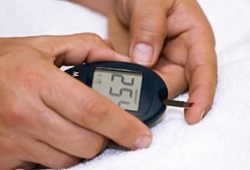 I'm a Type 1 Diabetic. That means my body produces no insulin of its own and I need to get insulin from outside sources. When I eat food, the sugar in my blood goes up and isn't delivered to my cells and my body starves while marinating it its own sugar. When I take insulin, my cells unlock, sugar (fuel) is delivered to the cells, and my blood sugar values go down. Eat, go up, take insulin, go down.
What's a Blood Sugar Meter do?
It does just that, it measures the level of sugar in my blood. I prick my finger, usually 10 times a day or so, and I put the drop of blood on a small gauze strip that goes into a machine and gives me a number. If it goes high too long, I'll die slowly. If it goes low too long, I'll die quickly. So, we need to keep that number as close to number as possible.
What's an Insulin Pump do?
 I took manual shots for 5 years. Some diabetics take just a few shots, 3 or 4, using a mix of short-acting (take a few hours) and long-acting (spreads over 12 or 24 hours) insulin. Others use a MDI (Multiple Daily Injections) technique, as I did, taking as many as 6-10 small shots of insulin a day. This is not uncommon and is often referred to as the 'poor man's pump.'
As a diabetic, once you've started taking that many shots, you get tired of taking shots. Enter the insulin pump. Once every 3 to 6 days, you poke a longish needle into your fat, then pull it out leaving a soft plastic canula embedded in you and held with tape. The insulin is sitting inside the pump and is pushed by a motor in the pump, slowly, through a long tubing and into you.
Now you can make tiny manual adjustments all day without shots. It's like the difference between making large, coarse movements of the steering wheel while driving and making those tiny back and forth adjustments you make just to say in your own lane on the road. Insulin pumps allow you 10-20x more precision over shots.
Everything inside an Insulin Pump is manual. It does nothing automatically other than a small background amount of insulin. My insulin pump gives me more control and means I get poked less often. But, it's not automatic. It doesn't cure or solve Diabetes.
So, to review. I did shots for 5 years, then a fairly standard insulin pump for 5 years. Then I got a CGM.
What's a CGM (Continuous Glucose Meter) do?
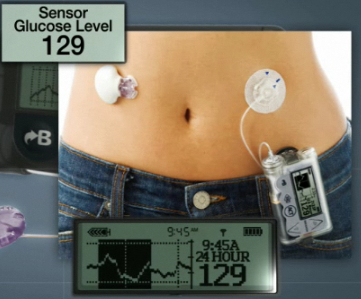 Pricking your finger and check your blood sugar tells you your sugar level now, but not 5 minutes ago, nor does it show the trend. Hey, my sugar is 80! Was it 200 a half hour ago? Or was it 50 a half hour ago. A single sugar value is about as useful as a single speed value or a single altitude value.
A CGM, or Continues Glucose Meter, is a transmitter that sits inside you body, usually inserted with a needle and a sensor then uses tiny micro-currents against your body's interstitial fluids to estimate (extrapolate) your blood sugar. It doesn't test blood and they are not typically very accurate. In fact, they have a little disclaimer that effectively says "don't make decisions using these values."
CGMs do not replace finger sticks. They are not as accurate, but they provide valuable slope data that diabetics need. Accurate single value readings via finger sticks, combined with not-as-accurate slope information, combined with the ability to easily give myself small or large amounts of insulin without shots (I change the pump every 3 to 6 days, that does involve a needle) means I've got the information I need to maintain good control.
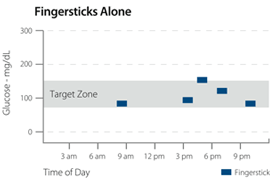
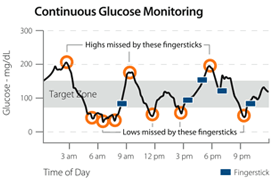
The Paradigm series of pumps are an Insulin Pump, but also a CGM receiver. They talk wirelessly to the CGM transmitter (see the picture above that is not my stomach) as well as wirelessly to a finger stick blood sugar meter. It's all one integrated thing.
Now, what's new in this new pump?
Medtronic MiniMed Paradigm "Revel" Insulin Pump
To review, insulin pumps are not automatic. They don't deliver without me saying so. While the pump talks wirelessly to meters and CGMs and stores values in memory, it doesn't act on them. There is no "closed loop" system. The delays involved are too great. However, the new "Revel" pump does add a number of cool new features that are making my life easier already. I think it's a great upgrade and if you have a MiniMed pump you should try to upgrade with their "Pathway Program." It's worth it.
New Features
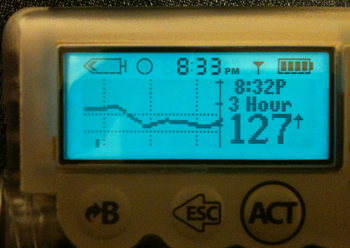
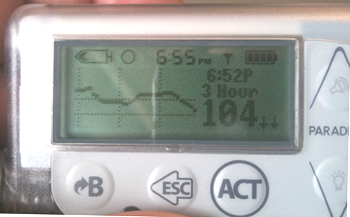
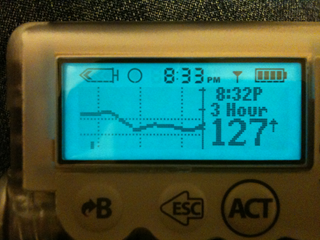
Better charts. Previously the charts were either 3 hours or 24 hours. Far to zoomed in, or so far out as to be useless. Now you can zoom 3, 6, 12, 24. Here's some screenshots:
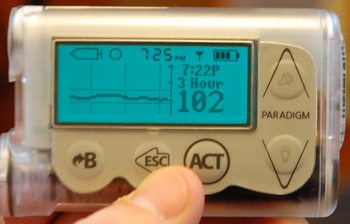
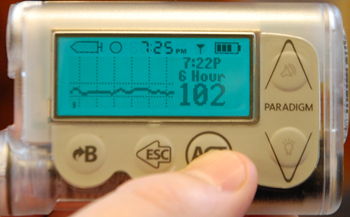
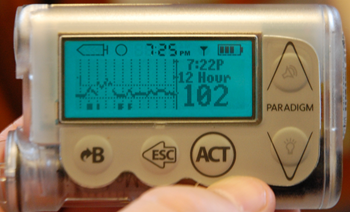
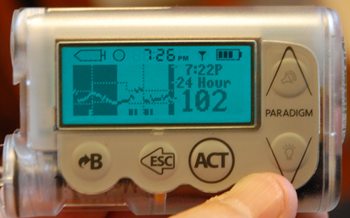
It was amazing how this apparently small upgrade changes the experience with the pump. The 6 hour view is a dream.
Predictive Alerts
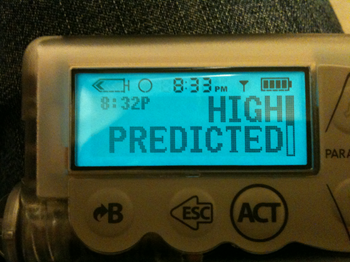
This is the killer feature that has already helped me at least twice a day in the last week. The new Revel has a "rate of change" detection algorithm that is totally user-settable. If the pump decides that you will hit a high blood sugar if your current rate of change goes unchecked, it'll let you know via an alarm. This is the one feature I always needed and it works just as you'd wish it did.
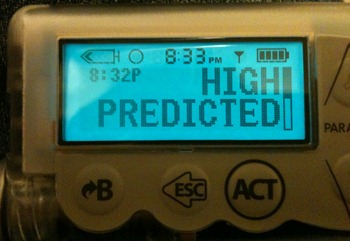
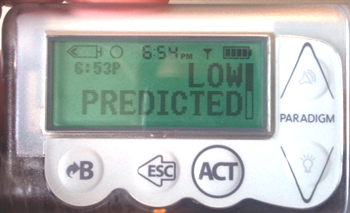
This feature did initially cause me to stack insulin a bit and caused a few lows as I was acting extra aggressively to squash highs, but I am finding I'm getting used to it. I wish it hadn't taken 5 years to get it. That's the tragedy of medical devices. You're thrilled with your multi-touch color screen portable device and I'm happy if I get one firmware update every 5 years. The difference is, my phone crashed twice today. This pump has never crashed in 10 years. We sacrifice innovation for stability.
Subtle but Important Improvements
One of the most important numbers for a pumper is the amount of insulin that's "pending" or "active." Most insulin takes about 3-4 hours to get out of my system, so if I take 5 units now, and 5 more units in an hour, that's stacking doses. If I remembered or was told that I had ~5 units active, I might not have taken that second dose and could avoid a nasty low. The Revel automatically calculates the active insulin and shows you it in three new places. First, on the status screen, second in the manual bolus (dose) screen, and again on the Bolus Wizard. It was buried in the UI before, now it's front and center.
The motor is more precise now, letting you do basal rates as low as 0.025 units per hour, crucial for young people.
Conclusion
This upgrade, the Revel, makes a great pump better. It was totally worth the $399 Pathway upgrade. If you're on a Minimed pump, get the upgrade. If you're not on a pump, consider getting one, it'll change your life.
If you found this interesting, please consider helping fight diabetes: http://hanselman.com/fightdiabetes or tweeting the link http://hnsl.mn/fightdiabetes
Hosting By

 My two-hundred-and-twelfth podcast is up. The worst show ever? Perhaps, but it's Meta! It's Joel Spolsky this week, the other half of the StackOverflow Podcast, chatting with Scott this week about podcasting. How does Joel record shows? How does Scott? Is this the end of the StackOverflow show? How does Leo Laporte manage? Should we visit his house? All this, plus sour grapes

 Building quality software is never easy. It requires skills and imagination. We cannot promise to improve your skills, but when it comes to User Interface and developer tools, we can provide the building blocks to take your application a step closer to your imagination. Explore the leading UI suites for ASP.NET AJAX,MVC,Silverlight,Windows Formsand WPF. Enjoy developer tools like .NET reporting, ORM,Automated Testing Tools, TFS, and Content Management Solution. And now you can increase your productivity with JustCode, Telerik’s new productivity tool for code analysis and refactoring. Visit www.telerik.com.


 Got an interesting question on Twitter, and got a fabulous answer in email from

 Two months before my 21st birthday I started peeing a lot. A LOT. Like I was drinking four 2-liter bottles of Sprite a day and was still thirsty beyond belief. We'd just had a family photo taken and I was 130lbs on a 5'11" frame (for those of you outside the US, that's thin.) I was wasting away and looked like death. My father, a Portland Firefighter and Paramedic for thirty years smelled the sugar on my breath and sent me right away to the hospital where my blood glucose level was higher than the meter could read...and it's supposed to be under 100mg/dl.
 Perhaps you've searched the web and found my blog useful in the past or you've seen me speak at a conference or local user's group. Or, you've hung out here for years (